column


Kurage Wonder Research Club Member's Observation Log / Atlantic Bay Nettle Edition
- Introducing the animals
- Kyoto Jellyfish Research Department

Kurage Wonder was established in 2020. Here you can encounter around 30 different types of jellyfish.
Jellyfish have a wide variety of characteristics. By learning about the highlights of each species, you may be able to find your favorite jellyfish.
Bay nettles that live in brackish water
While most jellyfish live in the ocean, did you know that they can also be found in brackish water, where saltwater and freshwater mix?

The Atlantic bay nettle is a jellyfish that inhabits the east coast of the United States and the Gulf of Mexico. Originally considered the same species as the larger Atlantic sea nettle, recent research has led to a reclassification, and it was reclassified as a separate species in 2017. It can be distinguished from the Atlantic sea nettle by differences in size and the number of tentacles. When fully grown, its bell diameter reaches about 15 centimeters, and it is a beautiful jellyfish that drifts leisurely through the water.

The secret to transparency
At Kyoto Aquarium, they feed the juveniles brine shrimp, a type of zooplankton, and Moon jelly. They start eating brine shrimp as soon as they are born, and when their bells grow to about the size of a one-yen coin, they begin eating moon Moon jelly.
They are characterized by their white, transparent caps and long, lace-like oral arms, but if they only eat minced red mysid shrimp, the area around their stomachs will develop a darker color, presumably from the food. Both individuals in the photo have caps about 10-15 cm in diameter, but can you see the difference in the transparency of their caps?


We are very particular about the type of rice we use to raise the umbrellas, in order to bring out their natural transparency, so please take a look.
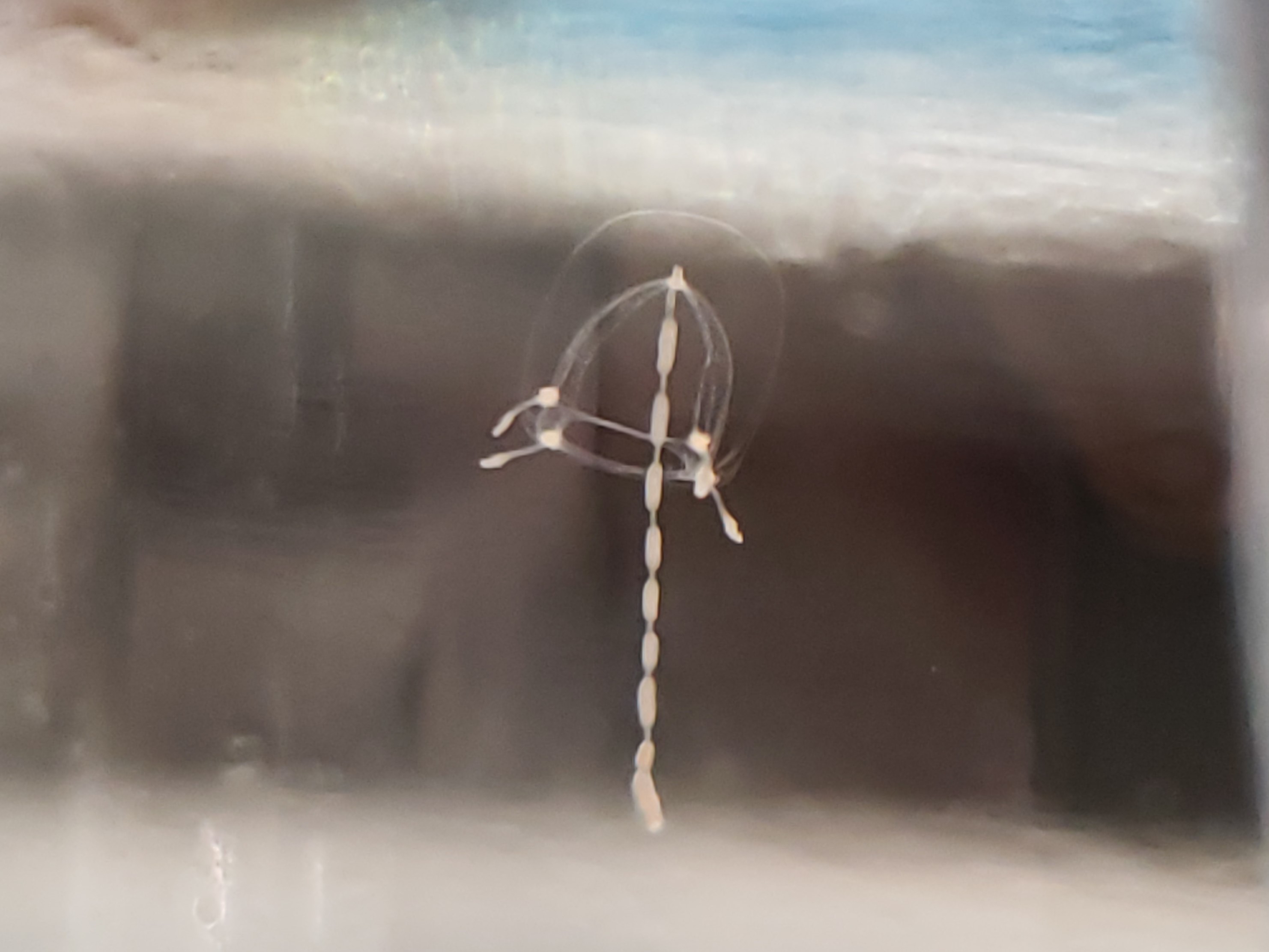
Incidentally, newborn Atlantic bay nettle babies are very small and transparent, making them extremely difficult to spot. Can you find the shape of the baby in the picture?


I want to see them! Jellyfish eggs!?
Have you ever wondered how jellyfish, which lack brains and cannot communicate, manage to reproduce? Each species of jellyfish has genes programmed to release eggs or sperm when stimulated in the same way, allowing them to fertilize their eggs underwater. Many people express a desire to see jellyfish eggs, but after successful fertilization, the eggs develop into larvae and then transform into anemone-like polyps within a few days. However, there are opportunities to see jellyfish eggs!
Many jellyfish release their eggs in response to light, and the Atlantic bay nettle is one of them. Every morning, when the aquarium lights are turned on, they all begin releasing their eggs at once, filling the tank with them.

When I peered into the tank, it was full of tiny grains, so I thought they might be eggs, but it turned out to be plankton, their food source. I was a little too late.
You're more likely to find them right after the aquarium opens, so if you're interested in jellyfish eggs, be sure to make it an early morning activity and try observing them.
[Exhibition and Animal Care Team, Mutsuura]
Check out the Kyoto Jellyfish Research Club for other jellyfish columns!
Related Columns
-
 Introducing the animalsKyoto Jellyfish Research Department
Kurage Wonder Research Team Observation Journal / Kurage Wonder's Birthday
-
 Introducing the animalsKyoto Jellyfish Research Department
Kurage Wonder Research Team Observation Journal / White Jellyfish
-
 Introducing the animalsKyoto Jellyfish Research Department
Kurage Wonder Research Club Member's Observation Log / Jellyfish Edition

Column List