column


Must-see! Find tips for your summer vacation research project at the aquarium
- Introducing the animals
- Behind the aquarium
With summer vacation upon us, it's time to start thinking about independent research projects. However, it can be difficult to decide on a topic, right? Today, we'll be introducing some tips for independent research projects that you can find at the aquarium!
Different habitats in different river basins
Many people will say, "I already know that!" when they hear that there are different types of fish that live in rivers and those that live in the sea. But did you know that the fish that live in rivers also differ depending on the river basin?
A river basin is mainly divided into "upstream," "middle," and "downstream." The upstream is closer to the river's source, while the downstream is closer to where it connects to the sea. Additionally, as you go from upstream to downstream, the water flow becomes gradually slower and the size of the stones on the riverbed also varies. Even within the same river, the environment changes depending on the basin.
In the upstream where the water is clear, there are many large fish such as char and Masu salmon trout, in the middle reaches there are many large fish such as Freshwater minnow, dace and Japanese aucha perch, and in the downstream there are many large fish such as Common carp and crucian carp.
In the Kyoto Aquarium's "The River of Kyoto" area, an aquarium that recreates the Yura River displays fish from each river basin. Although it looks like one aquarium, it is actually divided into three separate aquariums, one for each basin, so take your time to compare the different types of fish and take a closer look at the tanks!
What do animals eat?
It's mealtime for animals. Paying attention to not only how animals eat their food, but also the food they are eating may reveal hidden hints for your independent research project.
First, the African penguin are fed. At Kyoto Aquarium, they are given a whole horse mackerel. Mealtime is very lively! They call out the horse mackerel by name as they feed it, but it's just one bite.
Other animals that swallow fish whole include marine animals such as fur seals, seals, and dolphins. It's a hearty meal for all of them.
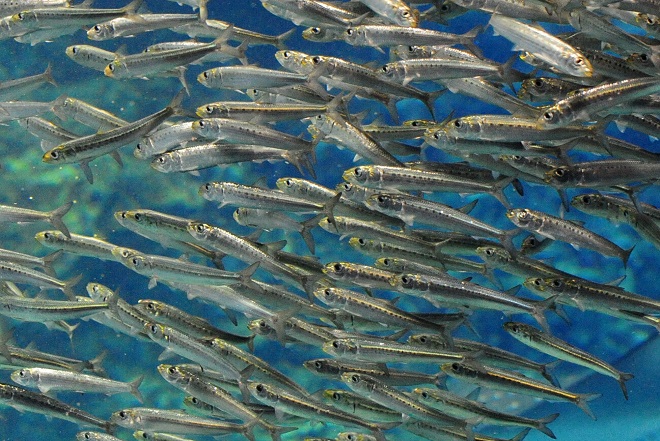
Additionally, the approximately 10,000 sardines swimming in the large "The Sea of Kyoto" tank are fed a meal of zooplankton such as the isazamemi (sardine shrimp). They do this by opening their mouths wide, swallowing the meal along with seawater, and then skillfully filtering it out with their gills.
Jellyfish also eat zooplankton. When they eat food by entangling it in their tentacles, the food gathers in the center of their umbrella. A jellyfish's stomach is shaped like a four-leaf clover and can be clearly seen after eating.
After eating the rice, you can see the color of the rice and it's beautiful!
At Kyoto Aquarium, you can observe the "mealtimes" of various animals. Enjoy "mealtimes" from various perspectives, such as what kind of food they eat and how they eat.
How much rice do you eat?
Next, take a look at the amount of food they eat. For example, Japanese giant salamanders eat a few fillets of a fish called dace. However, they don't eat it every day; about two times a week is enough.
Bottlenose dolphins eat about 15 kilograms of food every day, such as saury, horse mackerel, mackerel, and squid. That's a lot.
So, what is the reason behind the difference in the amount of food that different animals eat? Of course, one reason is that animals have different weights, so the amount they eat varies. However, that is not the only difference.
The difference lies in cold-blooded and warm-blooded animals!
Have you ever heard of the terms poikilothermic and homeothermic? You may have learned about them in class. animals that change their body temperature to suit their living environment are classified as poikilothermic, while animals that maintain a constant body temperature regardless of the surrounding temperature are classified as homeothermic.
Cold-blooded animals are mainly amphibians, reptiles, and fish, while warm-blooded animals include mammals. The giant salamander, an amphibian, is a cold-blooded animal. Its body temperature is adjusted to the temperature of the surrounding water, so it does not require as much energy as warm-blooded animals.
And mammals like bottlenose dolphins are warm-blooded animals. Warm-blooded animals maintain a constant body temperature regardless of the surrounding temperature. To do this, they need a lot of energy, so they need more food than cold-blooded animals. We humans are also warm-blooded animals.
Observe the differences between fur seals and seals!
Kyoto Aquarium is home to Southern American fur seals and spotted seals. Can you tell the difference between fur seals and seals? Take a close look at each species and discover the many differences between them.
Part 1: How to swim
When you observe Southern fur seals in the water, you can see that they swim with rocket-like speed. They swim by flapping their flipper-like forelimbs, almost as if they are wings. Sea lions swim by swaying their hind limbs and bodies from side to side. Their movements may seem slower than those of fur seals.
Part 2: How to walk
If you observe them on land as well as underwater, you will see differences. That is, the way they walk. Fur seals move by using their front and back legs to support their bodies. Seals move by lying on their stomachs, so you will immediately notice the difference in the way they move.
3. Do you have earlobes? Or not?
There is another difference between fur seals and seals. If you look closely at their faces, you will notice that fur seals have small ears. On the other hand, seals do not have earlobes, but instead have small holes.
The more you observe, the more differences you will find! If you notice any, please let the Kyoto Aquarium staff know.
Let's use the "Kyoto Aquarium SDGs Book"
We also recommend making use of the Kyoto Aquarium SDGs Book, which will give you an opportunity to think not only about the characteristics of animals but also about the natural environment.

This book will help you to look at the nature around you by comparing the various mechanisms of aquarium water temperature regulation and filtration with the natural environments of oceans and rivers. While observing animals, you can also think about the SDGs.
Click here for details
Above are some tips for independent research.
Aquariums are a treasure trove of topics for independent research. If you stroll around Kyoto Aquarium, you're sure to make lots of new discoveries! Have fun and find your own interesting theme!
(All images are for illustrative purposes only)
Column List